What Are Burpees?
Burpees are one of the most effective bodyweight exercises—and one of the reasons you’ll find them in almost every type of workout. Why? Because they combine a squat, plank, push-up, and jump into one continuous movement, engaging almost every major muscle group at the same time.
They are considered a high-intensity exercise commonly used in HIIT (High-Intensity Interval Training) to help burn fat, improve cardiovascular endurance, and boost overall fitness—all without the need for equipment and virtually anywhere.
Benefits of Burpees
No matter your fitness level, performing burpees correctly and consistently can help you:
- Improve cardiovascular endurance in a relatively short time
- Strengthen your entire body with a single exercise
- Increase your metabolism—even after your workout is over
- Burn a high number of calories in a short amount of time
- Enhance coordination, agility, and explosive power
How to Perform Burpees Correctly (Step-by-Step)
Proper technique—not speed—is what makes the difference. Follow these steps:
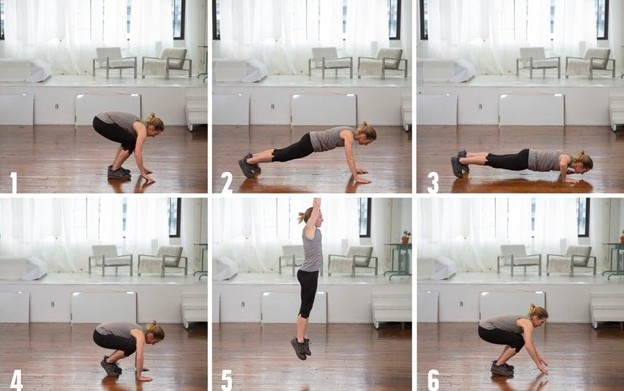
1. Start Standing
Stand with your feet shoulder-width apart and keep your core engaged.
2. Lower into a Squat
Bend your knees and place your hands on the floor just in front of your feet.
3. Jump Back into a Plank
Jump both feet back into a plank position while keeping your body in a straight line, your core tight, and your lower back stable.
4. Perform a Push-Up (Optional)
Lower yourself under control until your chest nearly touches the floor, then push yourself back up.
5. Jump Your Feet Forward
With one explosive movement, jump your feet back toward your hands.
6. Jump Up
Explode upward into a vertical jump, reaching your arms overhead, then land softly with control. That’s one complete burpee.
Common Burpee Mistakes to Avoid
Most mistakes aren’t about the movement itself—they’re about poor execution, which can increase the risk of injury.
- Arching or sagging the lower back in the plank: Keep your body aligned in a straight line. Letting your hips drop places unnecessary stress on the spine.
- Poor landing mechanics: Land softly with slightly bent knees to absorb the impact. Avoid landing with locked legs.
- Moving too fast without proper control: Speed without good technique doesn’t improve results—it increases your injury risk.
- Failing to engage your core: A strong, active core is essential for stability and efficient movement throughout the exercise.
- Using a partial range of motion: Complete every phase of the burpee to get the full benefits.
Burpee Variations for Every Fitness Level
One of the biggest advantages of burpees is that they can be adapted to suit any fitness level. There’s no need to start with the most challenging version.
Beginners
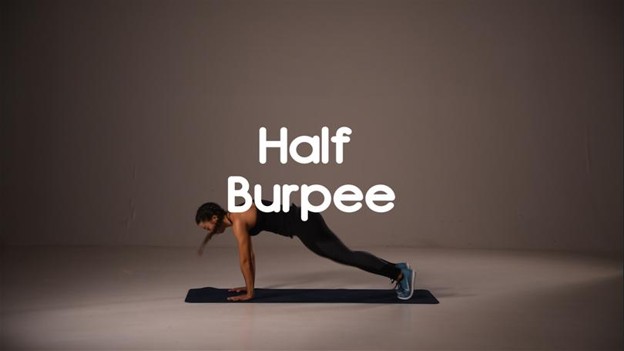
- Step-back burpees (step your feet back one at a time instead of jumping)
- Burpees without a push-up
How Many Burpees Should You Do?
The ideal number depends on your fitness level. More importantly, focus on maintaining proper form with every repetition rather than simply doing more.
- Beginner: 5–10 repetitions × 3 sets
- Intermediate: 10–15 repetitions × 3–4 sets
- Advanced: 15–20+ repetitions or HIIT intervals
Start conservatively and increase the volume gradually. Your body will let you know when it’s ready for more.
Frequently Asked Questions
I’m a beginner. Are burpees suitable for me?
Yes, provided you start with easier variations such as step-back burpees or burpees without the push-up. The key is to develop proper technique before increasing intensity or speed. Even at a lower intensity, burpees can deliver excellent results.
Do burpees really burn fat?
Yes—and very effectively. Because burpees are a high-intensity, full-body exercise, they significantly increase your energy expenditure during your workout. They also contribute to the afterburn effect (EPOC), meaning your body continues burning additional calories even after you’ve finished exercising.
How often should I do burpees to see results?
Performing burpees 2–4 times per week is generally enough to notice improvements. Be sure to allow adequate recovery between sessions, as burpees are physically demanding and your body needs time to recover and adapt.
Conclusion
Burpees are one of the most complete exercises you can include in your training routine. They combine strength, cardiovascular endurance, and explosive power into one movement—all without equipment or a gym.
The secret isn’t doing as many burpees as possible. It’s performing them with proper technique. Start with the variation that matches your current fitness level, progress gradually, and stay consistent. The results will follow
Sources
American Council on Exercise (ACE) (2021) Burpee Exercise Guide https://www.acefitness.org/resources/everyone/exercise-library/
National Institutes of Health (NIH) (2023) The 3-Minute Burpee Test: A Minimalistic Alternative to VO2max Testing https://pmc.ncbi.nlm.nih.gov/articles/PMC10080365/
Journal of Functional Morphology and Kinesiology (2024) The Relationship Between the Burpee Movement Program and Strength and Endurance https://www.mdpi.com/2411-5142/9/4/197
Perceptual and Motor Skills (2022) Burpee Interval Training and Psychological Response https://journals.sagepub.com/doi/10.1177/00315125221083180
ScienceDirect (2025) Equipment-Free Burpee Training and Health Outcomes https://www.sciencedirect.com/science/article/pii/S1728869X25000498
Cureus Journal (2023) The 3-Minute Burpee Test and Muscular Endurance https://www.cureus.com/articles/125529
ResearchGate (2019) The Burpee Enigma: Literature Review https://www.researchgate.net/publication/336282561